|
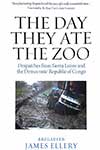
THE DAY THEY ATE THE Z00
Despatches from Sierra Leone
and the Democratic Republic of Congo
By Brigadier James Ellery
|
The culmination of Brigadier James Ellery`s military career, including the transition to civilian life which followed it, was not just out of the ordinary but unique. It comprised four high-level military-diplomatic appointments in African and Middle Eastern countries which were in the grip of, or bordering on, anarchy, and steeped in bloodshed. This book is his account of the first two: Sierra Leone and the Congo.
In July 1999, as a serving colonel, Ellery volunteered for a tour of duty as chief of staff of the UN`s nascent Mission to the Democratic Republic of Congo. Earlier that month a ceasefire had been agreed between the Congolese government and the six neighbouring countries whose forces had been in that country, fighting either for or against Congolese President Laurent Kabila. The role of the UN mission was to monitor the ceasefire and implement the peace agreement.
When Ellery arrived, he found that the country was, in his words, ‘quite simply in a state of meltdown’. Law and order had long since broken down. The fighting had been characterised by barbaric atrocities. Famine was widespread, so much so that in the capital, Kinshasha, the animals in the zoo had been slaughtered for food (hence the book’s title). Exactly one hundred years earlier Joseph Conrad had famously described the country as ‘the heart of darkness’; not much, it seemed, had changed. Indeed, prospects for the Mission did not look rosy; the UN had been unable to find either a leader for it, a Special Representative to the Secretary General (SRSG), or a force commander, so both tasks fell to Ellery.
This unusually large responsibility brought with it considerable challenges. The Congo is a country the size of Europe, with a population of some fifty million. President Kabila was increasingly reviled, accused by many of murder and torture, and, as Ellery recounts, ‘was actively trying to whip up the population against us’. Moreover, the Mission initially lacked the troops, equipment and funds to make a significant impact. Ellery recognised that to make any impact he needed to deploy immediately what troops he had to critical areas. He arranged for six UN transport planes to be made available, but the evening before the much-heralded deployment he was told that for legal reasons they could not be used. With a Nelsonian disregard he went ahead, only to be later presented with a personal bill for $75,000 (with considerable ingenuity he persuaded his new friend, the French ambassador, to pay it).
Ellery`s account of his five months in the Congo is vivid and fast paced, but also modest. The citation for the CBE which he was subsequently awarded tells of his achievements in establishing the Mission, stabilising the situation, and doing so in the face of institutional opposition and intimidation, personally targeted as an enemy of the Congolese people, with his life publicly threatened.
Just over a year after leaving the Congo, and now a brigadier, he was selected to be chief of staff of another UN mission in Africa, this time in the diamond-rich country of Sierra Leone. Like the Congo, Sierra Leone had been riven by civil war, but here even longer and more brutal: in the ten years from 1991 an estimated 50,000 of its people had been killed and over half a million displaced. The rebel Revolutionary United Front, led by its founder, Foday Sankoh (described by Ellery as `the Devil incarnate`) were merciless terrorists whose trademark was chopping-off the hands of their opponents` children. (The book contains harrowing pictures of some of the survivors.) By 2001, the UN Mission, established in 1999, had been given a powerful peace-enforcement mandate and was moving into rebel-held areas to disarm rebel soldiers.
Ellery`s story of his time in Sierra Leone comes in the form of the regular, roughly fortnightly despatches which he sent to a close circle of friends in Britain. These reports, each averaging around 700 words, were written very much in confidence and, added footnotes apart, are reproduced unedited in the book. They reflect their author`s thoughts and feelings at the time. Written in a notably forthright style, in very plain language, they are clearly not intended for publication.
The despatches chronicle the utter chaos in Sierra Leone, with graphic illustration of the level and degree of violence and corruption. Examples abound. Freetown, the capital, ‘is in decay, a haven for violent crime’, where ‘armed robbery is a regular occurrence’. Around the country, prisons have a poor record of retaining inmates: one large prison has three breakouts in a single year, in one of these all the prisoners escape. A coup attempt, led by former Head of State Johnny Paul Koroma, fails but comes close to creating pandemonium throughout the country. Violence and intimidation surround the illicit diamond trade which itself ‘poses the greatest threat to Sierra Leone’s fragile peace’. Fortunately, the troops of the UN Mission, most of whom come from Commonwealth countries, are of a high standard: ‘only [their] presence’, writes Ellery, ‘prevents a return to anarchy’. And he castigates the British government which ‘alone in the Security Council …now recommends an acceleration of the force`s drawdown’.
An increasingly high priority for Ellery is bringing to justice the senior war criminals, including Sankoh and Koroma. Indeed, he extends his tour of duty to see this process through. It leads to a dramatic climax. When the UN-mandated Special Court for Sierra Leone intimates its intent to indict the most notable criminals, Ellery discovers that his Nigerian boss, SRSG Oluyemi Adeniji, intends to spirit these individuals away to Nigeria to avoid arrest. Ellery confronts Adeniji, warning him that this will inflict near fatal damage on the Mission. Ellery informs UN headquarters accordingly. The timing of the arrest operation is withheld from the SRSG. When told that the arrests have been made, a furious Adeniji demands that UN headquarters sack Ellery immediately. But following a hastily-convened enquiry it is the SRSG who is removed.
This book is remarkable on several levels. It provides a graphic insight into two major UN Missions at the turn of the 21st century. It illustrates the huge challenges which face the leaders of such Missions. And as a memoir it reflects the character of its author, not least the degree to which, despite all the trials and tribulations that face him, he maintains his relish and enthusiasm for the demanding role he has undertaken. Finally, perhaps most significantly, the confidential despatches are, and will remain, important primary-source material for historians now and in the future.
The second volume of Ellery`s memoirs, covering his diplomatic appointments in Iraq and Sudan, will be published later this year.
John Kiszely
Published by Nine Elms Books
|
|